
What happens when autonomy goes too far

Summary: Senior leadership teams are usually full of smart, capable people. But individual capability doesn’t automatically translate into a strong team. Without clear direction from the person leading them, even experienced executives will naturally gravitate towards their own priorities and responsibilities.
The leader’s job isn’t to have all the answers or dominate the room. It’s to create clarity about where the team is going, what matters most and what they need to achieve together.
Giving senior people autonomy is important. Leaving them to it is something else entirely.
You can learn quite a lot about a leader in the first five minutes of a team meeting.
I was reminded of that recently when I facilitated a session with a senior leadership team. The team leader had brought me in to work with them and, as agreed, I asked him to say a few words to get us kicked off. Why he had brought everyone together? Why this mattered? What he wanted the team to get from the day?
I was expecting a short, energetic opening that would give everyone a sense of purpose and set the tone for the day.
But what followed felt a bit like a weak handshake. A few lukewarm, low energy words, no real sense of this matters or this is what I want us to achieve together. And before I knew it he had handed it back to me.
It struck me because this was his team, his meeting and a day he had decided was important enough to take everyone away from their day jobs for. Yet you wouldn’t really have known it. And as the day went on I realised that the opening wasn’t just a slightly flat start. It was actually a pretty good reflection of what was going on in the team.
These were smart, experienced, capable people. They knew their stuff, had strong views and were clearly used to getting things done. But at the same time everyone seemed to be looking at the business from their own seat. There was very little sense of what are we, as a team, trying to make happen?
And this wasn't a team problem. It was a leadership problem!
Because smart, senior people don’t automatically become a team just because you put them around the same table. Of course they will gravitate towards their own areas, their own priorities and the things they are responsible and held accountable for. Why wouldn’t they?
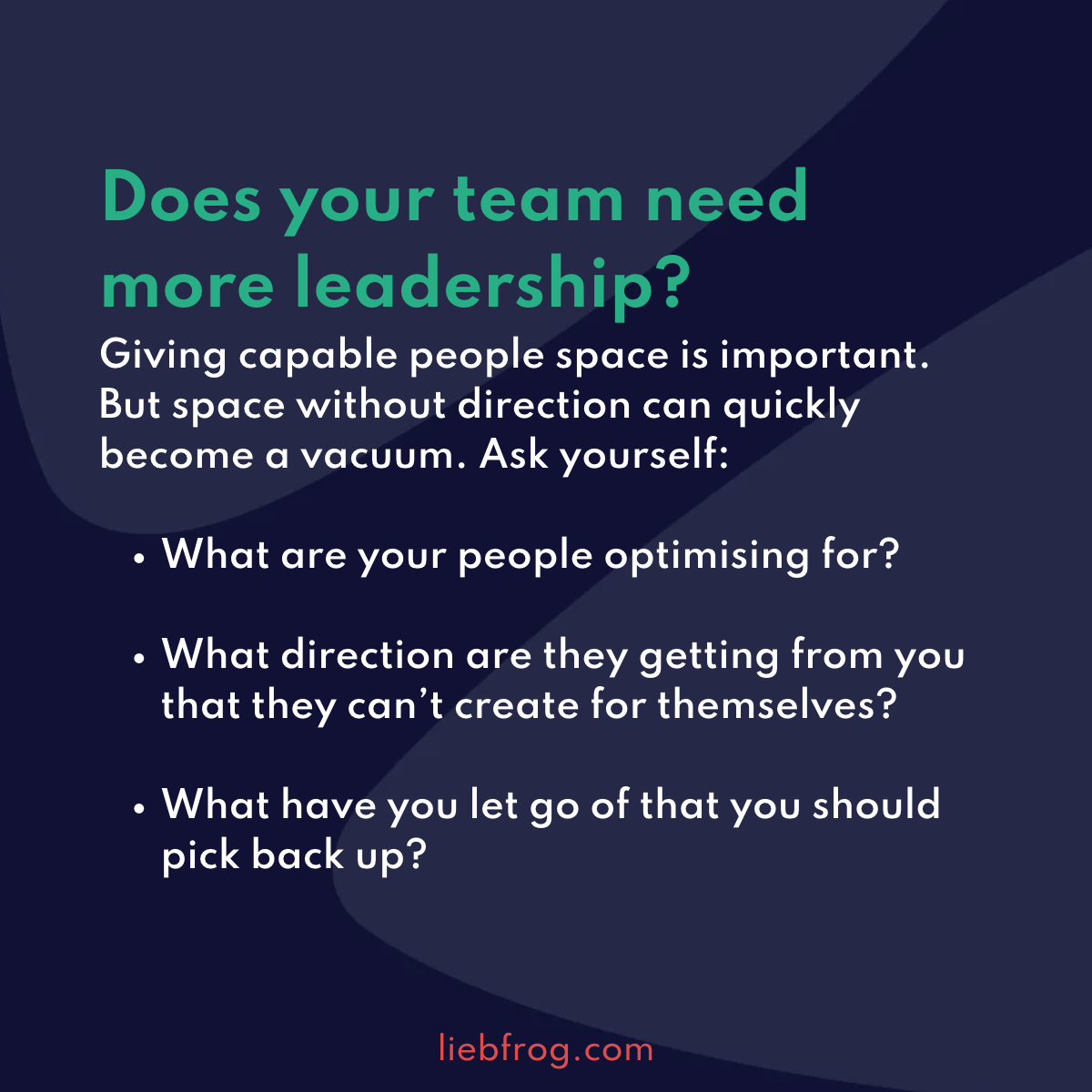
It’s the leader’s job to ensure they look up. To remind them where they are going and what matters most. To make the connections between the different parts of the business and create a sense of shared responsibility for the things that don’t sit neatly in anyone’s individual remit. And sometimes to challenge them: I know this makes sense from where you’re sitting, but is it the right thing for the team?
That doesn’t mean having all the answers or being the loudest person in the room. It certainly doesn’t mean telling clever, experienced people how to do their jobs. But it does mean giving them enough direction to turn a collection of very capable individuals into a team.
I wonder whether this gets missed precisely because senior teams are full of capable people. You look around the table and think: They’re good. They know what they’re doing. I don’t need to interfere. And perhaps you don’t.
But there’s a big difference between giving people autonomy and leaving them to it.
Without direction, you can have a room full of very smart people, all working incredibly hard and all doing perfectly sensible things, all pulling in different directions.
Or, sometimes, in no direction at all.
If you lead a team of capable senior people, they don’t need you to do their jobs for them. They need you to do yours.
November 2026
If you’ve enjoyed this article and don’t want to miss future reflections and resources then do sign up for monthly newsletter.